

What is last-mile logistics?
The last mile refers to all the agents, operations, and equipment involved in the final segments of the supply chain for goods or services.
As the final link in a product’s logistics chain, last-mile logistics involves delivering goods on time to the end customer—whether at their home or at pickup points (relay points, lockers).
What is last-mile optimization?
Last-mile optimization involves implementing effective strategies to streamline the final stage of the delivery process. Using advanced mathematical technologies and artificial intelligence, businesses can conduct a detailed analysis of delivery operations, identifying factors that save time on routes while better managing human and material resources—all while respecting operational constraints. The result? Reduced costs and lower CO₂ emissions.
What are the current challenges of last-mile optimization?
Having grown significantly in recent years—especially during the pandemic—e-commerce has become a staple in French consumer habits. Satisfied with positive online shopping experiences, customers increasingly favor this method, leading to a surge in market players as retailers expand their online presence to offset declining in-store sales.
In this context, delivery—and thus the last mile—has become a competitive differentiator. Today’s consumers expect multiple delivery options (based on time and location) and real-time order tracking. In short, they demand fast, low-cost, traceable, and flexible delivery. For e-commerce businesses, this creates a major challenge: optimizing customer service while staying competitive and profitable.
How can decision mathematics and AI optimize last-mile delivery routes?
Optimization algorithms are essential because last-mile logistics presents a highly complex, combinatorial problem. The sheer number of possible delivery routes makes manual evaluation impossible. That’s why decision mathematics—combined with industry expertise—is key to quickly identifying high-quality solutions that align with real-world constraints, service quality, and environmental requirements.
Constraint-based optimization algorithms help balance multiple objectives: minimizing costs, reducing distance traveled, and meeting delivery windows—all while ensuring efficiency.
How does EURODECISION support businesses in last-mile optimization?
Beyond route optimization, last-mile logistics involves many complex, often conflicting challenges: demand forecasting, agency and hub location, transport planning, picking, slotting, sorting machine scheduling, bin packing, and more.
At EURODECISION, we address each of these challenges using AI models. Our holistic approach also allows us to tackle multiple issues simultaneously. By customizing our algorithms and components, we help clients optimize their entire transport network—from the first mile to the last.
Do you have a last-mile optimization project? Contact us
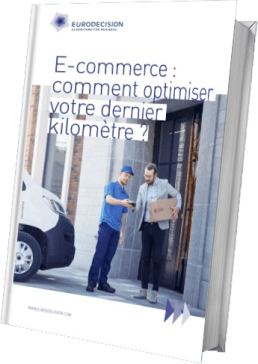 Download the White Paper
How does a last-mile optimization project work with EURODECISION experts?
A project involving a quantitative study of last-mile optimization follows this process:
- Scoping, data collection, and validation
- Model implementation, including potential adaptations of an existing model
- Creation of a digital twin (model configuration, reference database setup)
- Scenario optimization and comparison
- Roadmap to achieve targets, with support for implementation and deployment.
A project involving a decision-support tool begins with a prototyping study, followed by model industrialization, delivery/installation, and ongoing support and maintenance.
Why trust EURODECISION for your last-mile optimization project?
Decision mathematics relies on techniques in artificial intelligence, optimization, and computer science. At EURODECISION, we combine this expertise with deep industry knowledge: for over 30 years, we have developed recognized expertise in transport and logistics, trusted by the clients we support.
To address the challenge of last-mile optimization, we have developed decision-support tools that quantitatively balance conflicting objectives—such as minimizing costs while maximizing next-day parcel deliveries.
For example, in the UK, we assisted an urban e-logistics provider with a network of multiple delivery branches and a sorting hub. Facing urban traffic regulations that required replacing their thermal van fleet with higher cost-per-kilometer electric vehicles, they sought to optimize their routes. By testing various network reorganization scenarios (number, function, and location of branches and hubs), we identified an all-electric fleet solution that matched the cost of their previous thermal fleet setup.